ELGAR will drive pan-European synergies from top research centres developing quantum sensors. It will have a strong impact on GW astronomy because it opens a new window for GW observation and complements worldwide other instruments currently operating or under development.
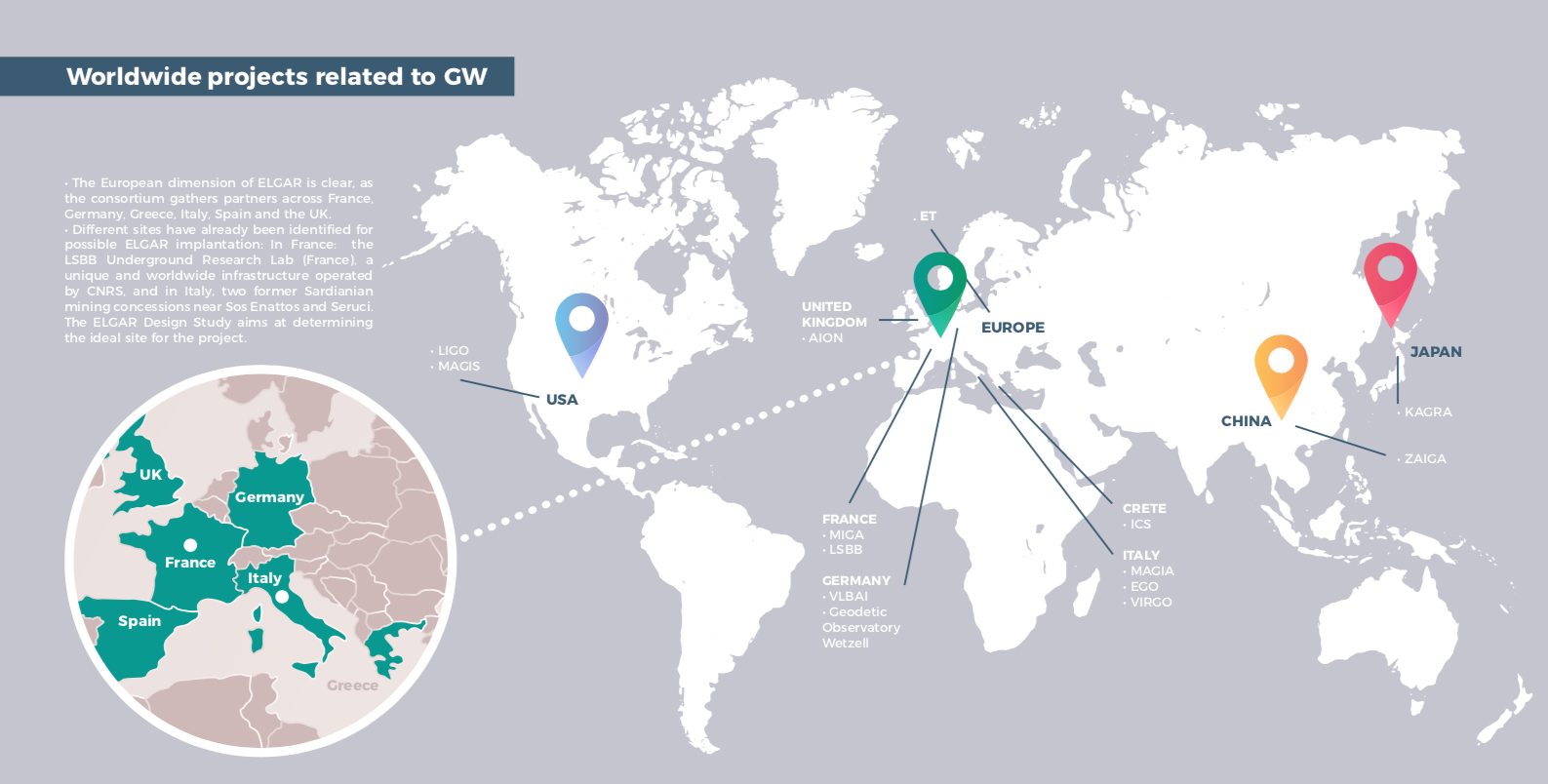
The program will directly inherit from national initiatives, such as the MIGA that will be used as a demonstrator using atom interferometry methods proposed by ELGAR, or the VLBAI and the MAGIA Advanced experiments. It is also strongly connected to existing infrastructures, e.g. the EGO that will connect the ELGAR community with the larger GW astronomy community, the Geodetic Observatory Wetzell which warrants a strong connection with the geodesy community and its geodetic techniques will be useful for choosing the best site for ELGAR instrument. The ICS centre will contribute the project through the respective teams ICS’s contributing laboratories and its vast experience in interdisciplinary research related to data and computational aspects. ELGAR could also benefit from a growing number of other national initiatives in Europe such as the AION program, or the industry connections of the National Technology Hub in Sensors and Timing in the UK.
ELGAR will complement the existing optical gravitational-wave instruments such as Advanced LIGO (aLIGO), Advanced Virgo (AdV), and the future detectors such as Einstein Telescope (ET) and LISA, which will enable to cover the full GW spectrum.